IoT Yocto v25.1.1 - 2026 Mar 16
IoT Yocto v25.1.1 release supports Genio SoC families built on the Yocto Scarthgap and Linux 6.6.y LTS branch. This document provides an overview of the major changes in v25.1 and v25.1.1.
Supported Boards
This release introduces support for a new SoC family:
This release also supports MediaTek SoC families:
MT8365 (Genio 350/G350)
MT8370 (Genio 510/G510) and MT8390 (Genio 700/G700) family
MT8395 (Genio 1200/G1200)
This release also supports the following boards:
Board Name |
|
|---|---|
|
|
|
|
|
|
Note: Genio 420/520/720 EVK shares the same MACHINE configuration ( |
|
|
Supported Software Features & Specs
Refer to the IoT Yocto Feature Table (v25.1.1) for the detailed software support status of the IoT Yocto v25.1.1 release.
This document includes:
Feature Table: Supported software feature list of IoT Yocto for each platform
Bootloader Driver: Supported drivers for each boot stage
Build Flavor: Supported build flavors and included packages
Specification: Supported software specifications for USB, Display, Video-in (Camera, HDMI-RX), Video Codecs, MDP (multimedia data format converter and resizer), JPEG, Audio, Wi-Fi and Bluetooth
Benchmark Suites: Supported benchmark tools and their versions
Stress Suite: Supported stress tools and their versions
Suspend & Resume Table: Suspend and resume behavior of each driver
DTBO List: List of DTBO (Device Tree Blob Overlay)
Bin & License Release Modules: List of proprietary modules and their licenses
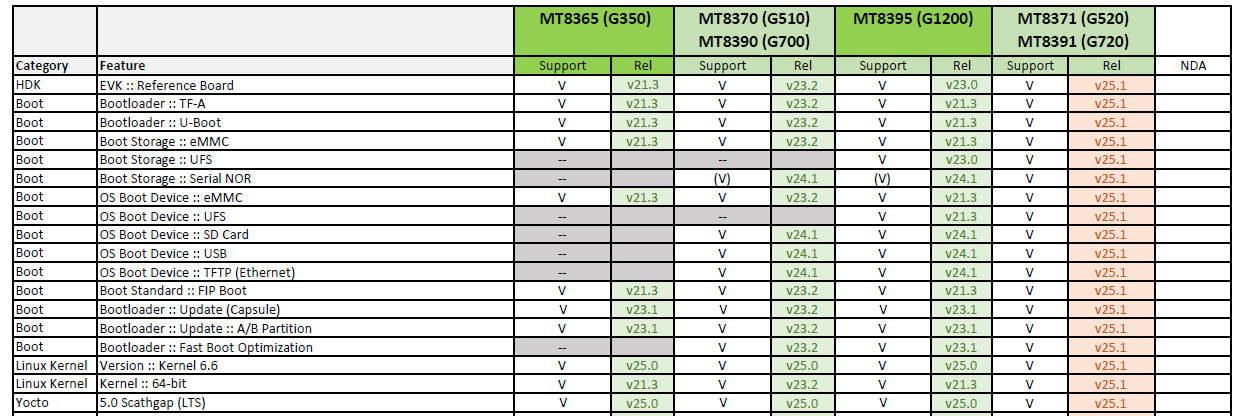
A Segment of IoT Yocto Feature Table (v25.1.1)
Prebuilt Images Download
The following prebuilt images are provided for evaluation and debugging purposes. They are not suitable for production use.
Demo Images
These demo images are built from the rity-demo-image recipe using the private (NDA_BUILD=1) configuration.
They are configured to help you evaluate, debug, and develop your own product images. These images are not suitable
for production use, as they have various debugging options enabled.
Board |
Boot Config |
Download Link |
MD5 Checksum |
|---|---|---|---|
eMMC boot |
c0a56a4ef11878355b2a34061de54404 |
||
UFS boot |
76d5a688df51ff00ebb0aa50ad344a37 |
||
eMMC boot |
1dede4efbd259f3ce2ab55e7f2e07457 |
||
eMMC boot |
055f7332564f2af2fde0ce6e106b0fae |
||
SPI NOR boot to UFS storage |
2dc5abcbd04dd403d3a9d80a3bc1c6cf |
||
UFS boot |
17c6c2329b051f125ada257b61ac99f1 |
||
eMMC boot |
948e3d7e4fd430b0b792c3b7f8ff86a9 |
||
eMMC boot |
ff3f1eb3da4e7a19e33365555674fd68 |
Browser Images
These images are built from the rity-browser-image recipe with Chromium browser installed and with
the private (NDA_BUILD=1) configuration enabled.
They are configured to help you evaluate, debug, and develop your own product images. These images are not suitable for production use, as they have various debugging options enabled.
Board |
Boot Config |
Download Link |
MD5 Checksum |
|---|---|---|---|
eMMC boot |
cc6522ba77ddce6032cbadca5e361a53 |
||
UFS boot |
c7745e676c4a97d3e7a54effc467a1ca |
||
eMMC boot |
0684284a9059b8f4e7ab91763daf1f45 |
Public & Private Build Configuration
IoT Yocto has a configuration NDA_BUILD that controls if the recipe fetches software from
access-controlled “private” repositories. These private repositories are located under the
https://gitlab.com/mediatek/aiot/nda URL namespace, hence the name NDA_BUILD.
All the prebuilt images provided in this v25.1.1 release are built using NDA_BUILD = "1" configuration.
These images are also referred to as private build images.
By setting NDA_BUILD = "0", you could still build an IoT Yocto image with packages that are available
without explicit access permissions to the GitLab NDA namespace.
We call this a public build image.
In the public build configuration, some proprietary components are provided in binary-only format, and certain proprietary features are excluded, for example:
Security features are excluded, e.g.
eFuse writer and custom data field access
RPMB access API
ISP support for RAW sensors and YUV sensors on Genio 510, Genio 700 and Genio 1200 is excluded.
Starting from v24.0 release, we no longer provide prebuilt public images for download and evaluation,
as their features are a subset of the private images. The public build configuration is still supported,
so developers can build images themselves using the NDA_BUILD = "0" configuration.
You may find the NDA features, binary-released modules and their licensing in IoT Yocto Feature Table (v25.1.1).
Note
You don’t need a GitLab account to download the prebuilt images, but you need to agree to the Software License Agreement.
You don’t need a GitLab account to build the public image configurations.
You need a GitLab account and contracts with MediaTek to access and build the private image.
Source Code Download
Important
Please read and agree to the Software License Agreement before accessing or using IoT Yocto software. If you do not agree to the terms and conditions of the Software License Agreement, you must not access or use the software.
To download and build IoT Yocto recipes, please use the rity-scarthgap-v25.1.1 tag for the repo manifest file:
repo init -u https://gitlab.com/mediatek/aiot/bsp/manifest.git -b refs/tags/rity-scarthgap-v25.1.1
To fetch source code and build images using these Yocto recipes, please refer to steps in Build from Source Code.
Tools
Genio Tools v1.7 is released to support Genio 420 (MT8371 LV), Genio 520 SoC, and Genio 720 SoC in addition to previously supported Genio SoCs.
You must update Genio Tools to load built images onto Genio 520/720-EVK boards.
Please refer to Get Started with IoT Yocto and Genio Tools for detailed usage.
Major Software Package Versions
Yocto LTS updated from Scarthgap 5.0.8 to 5.0.12
Linux kernel updated from 6.6.37 to 6.6.92
ATF version kept at v2.6
U-Boot version kept at v2022.10
OP-TEE version kept at 3.19
Mali GPU DDK version kept at r48
Major Changes
IoT Yocto v25.1.1 is a minor update to v25.1 with additional features:
Add Genio 420 (MT8371 LV) BSP support.
Add DPoC (DisplayPort over Type-C) support for Genio 420/520/720.
Re-enabled UVC Gadget feature.
Genio 420 Support
IoT Yocto v25.1.1 introduces support for Genio 420 (MT8371 LV). Genio 420 is pin-to-pin compatible with Genio 520 (MT8371 IV/AV), and shares the same BSP driver packages with Genio 520 and Genio 720.
All the software features of Genio 520 are applicable to Genio 420.
Genio 520 and Genio 720 Support
IoT Yocto v25.1 introduces support for Genio 520 SoC and Genio 720 SoC, with the following notable features:
Shared BSP
The Genio 520 and Genio 720 SoCs are pin-to-pin compatible. In addition, the Genio 720 BSP is also compatible with Genio 520. As a result, both Genio 520/720-EVK share the same
MACHINEconfiguration in the IoT Yocto recipes inmeta-mediatek-bsp.
Automatic DRAM size detection
Genio 520 and Genio 720 support both LP4X and LP5(X) DRAM. The BSP bootloader supports runtime detection of DRAM type and size, making it possible to reuse the same bootloader binary across different board designs with varying DRAM sizes and types.
Multiple boot storage options
Genio 520/720-EVK can be configured to boot from UFS, eMMC, or serial NOR flash. While the BSP drivers are shared, separate binary images must be built for each boot storage option. This is due to differences in bootloader headers and storage block sizes.
DPoC on Genio 520/720 is supported in v25.1.1 release.
To enable DPoC output in Genio 520/720-EVK, you need to load the
display-dpoc.dtbooverlay when flashing the v25.1.1 prebuilt image.Note that Genio 520/720 SoCs do not have an HDMI display interface. Please visit Genio Developer Center and download the data sheet for a complete list of SoC hardware features.
There are some limitations and known issues regarding the support for Genio 520 and 720:
ISP on Genio 520/720 is not supported in this release.
While the MIPI-CSI interface on Genio 520/720 supports IMX258 RAW sensor data transfer, the ISP hardware pipeline is not supported.
Boot logo and bootloader display driver on Genio 520/720 are not supported in this release.
For details, please refer to the feature table document.
General BSP Feature Changes
v25.1.1 also brings updates to other Genio SoCs, EVKs, and some software features:
New or Updated Features in v25.1.1
UVC Gadget is re-enabled in v25.1.1 release.
Chromium updated from 138.0.7204.293 to 138.0.7204.298.
New or Updated Features in v25.1
EBBR boot flow is now supported on Genio 520/720-EVK using serial NOR as boot storage.
ONNX Runtime is now integrated into IoT Yocto:
ONNX Runtime runs on CPU on Genio 510/700/1200.
ONNX Runtime supports NPU hardware acceleration on Genio 520/720.
CANBUS bridge MCP2518 on Genio 1200 EVK and Genio 520/720-EVK is re-enabled in this release.
(3rd Party) Chromium browser is re-enabled in this release. Also:
Chromium updated from 132.0.6834.6 to 138.0.7204.293.
Chromium browser now integrates with PipeWire framework.
(3rd Party) SerDes MAX96724 EVK support is integrated in this release.
(3rd Party) ASIX ax88179 Gigabit Ethernet driver is integrated in this release.
EOL Features
ncc-tflite: The on-device Neuron SDK compiler
ncc-tfliteis now deprecated and removed from IoT Yocto images. We encourage customers to use thencc-tflitecompiler running on Ubuntu OS(x86_64).
Developing Features
Ethernet TSN is not verified in v25.1.1 release.
Out of Scope Features
IoT Yocto does not provide an out-of-the-box battery management and charging control framework. Since battery management policies are highly dependent on the application scenario, we recommend adopting 3rd party battery charging solutions.
While ONNX runtime is supported in this release, the full-scale ONNX framework is not.
Notable Fixed Issues
v25.1.1 fixes the following major issues that occurs to v25.1 release:
[AUTO00842071][Genio 720] System unstable when looping glmark2 benchmarks
[ALPS10636360][Genio 720] Kernel error and shutdow while executing certain Neuron runtime model
Notable Known Issues
[AUTO00769395][Audio][DPoC] Noise on speaker-test after re-connecting to different DPoC monitors
[AUTO00771343][Genio510] MAX9286 may fail to open under rapid close and re-open scenario
[AUTO00773839][Display] DRM overlay plane content offset with negative plane coordinates